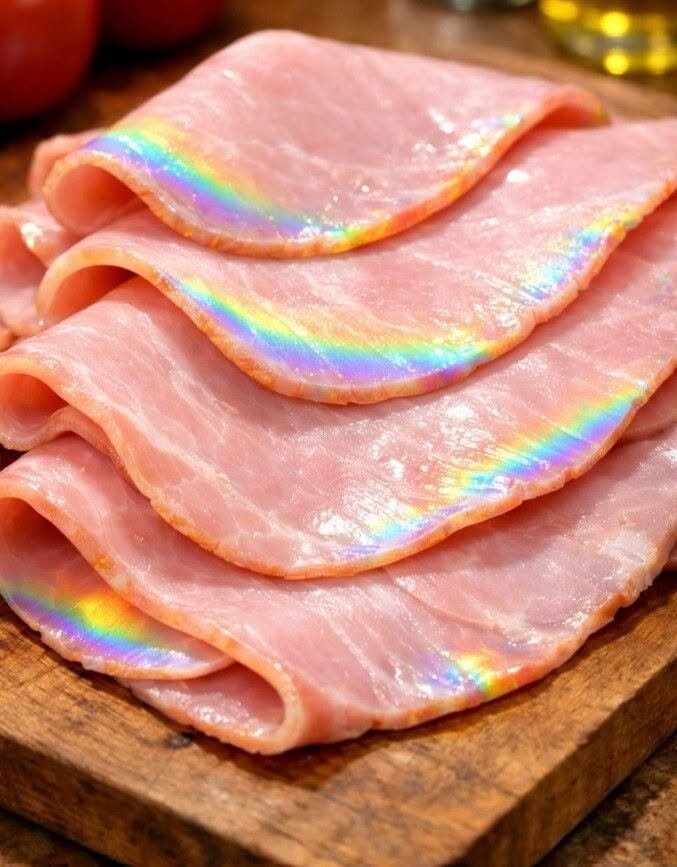
You open the fridge, take out a package of deli ham, and notice something unexpected: a rainbow-like shimmer across the surface of the slices. It can look strange, even alarming, and it’s natural to wonder whether the meat has spoiled or become unsafe to eat.
The good news is that in most cases, this colorful shine is completely normal and does not mean the ham has gone bad. Understanding why it happens and how to recognize true spoilage can help you decide whether your food is still safe.
What Causes the Rainbow-Like Shine on Ham?
The rainbow sheen seen on deli ham is usually caused by how light reflects off the surface of the meat, not by bacteria or decay.
Ham is made up of tightly aligned muscle fibers. When the meat is sliced very thinly, as deli meats often are, those fibers form a smooth, uniform surface. When light hits that surface, it can bend and reflect in different directions, creating a shimmering or rainbow-colored appearance. This effect is known as iridescence.
This same phenomenon can be seen on other smooth surfaces, such as CDs or soap bubbles. In meat, it is purely visual and has nothing to do with spoilage.
Why Deli Meats Show This Effect More Often
Several factors make deli ham more likely to display a rainbow shine:
Thin slicing exposes muscle fibers in a way that reflects light more clearly
Cured and cooked meats have smoother surfaces than raw meat
Firm muscle structure allows light to reflect evenly
Dark or pink meat color makes the sheen more noticeable
Because of this, the effect is common in ham, roast beef, and corned beef, but rarely seen in ground meats.
Does the Rainbow Shine Mean the Ham Is Unsafe?
No — the rainbow shine alone does not mean the ham is unsafe. If the ham:
Smells normal
Feels moist but not slimy
Has no unusual gray, green, or brown patches
Has been stored properly and used within a safe timeframe
then it is generally safe to eat, even if it looks shiny or colorful.
See next page…