Can You Prevent White Foam?
You may be able to reduce how noticeable it is, although you can’t always eliminate it completely.
Choosing a somewhat leaner ground-meat mixture can reduce the amount of rendered fat.
You can also make sure your meatloaf mixture isn’t excessively wet. Follow the recipe’s measurements carefully rather than adding significantly more milk, eggs, or other liquid ingredients.
Another helpful step is choosing an appropriately sized baking dish. If the meatloaf sits in a deep pool of rendered fat, the cooking environment can become different from what the recipe intended.
Some cooks also use a rack or perforated meatloaf pan to allow excess fat to drain away. If you choose this method, make sure the setup is stable and appropriate for your oven.
Should You Drain the Fat During Cooking?
That depends on the recipe.
Some meatloaf recipes are intentionally cooked with their juices and rendered fat because those liquids contribute flavor and moisture.
Other recipes are designed to allow excess fat to drain away.
If you notice a lot of liquid accumulating in the pan, you can carefully drain it if your recipe permits. But don’t repeatedly remove the pan from a hot oven unless necessary.
Every time the oven door is opened, heat escapes, which can affect cooking time.
More importantly, hot rendered fat is dangerous. Use oven mitts and stable cookware, and keep children away from the oven and hot pan.
What If the Foam Looks Strange?
White or pale foam is often associated with normal cooking reactions, but you shouldn’t ignore other unusual signs.
Be cautious if the meat had an abnormal odor before cooking, if it had been stored incorrectly, or if there were other indications that the raw meat was spoiled.
Also remember that harmful bacteria cannot be reliably detected by looking at the meat. USDA recommends following safe handling practices throughout preparation and cooking rather than relying on appearance.
If you are uncertain about the condition of the meat before cooking, it is better to discard questionable meat than to assume that baking will solve the problem.
Proper Handling Starts Before the Meatloaf Goes Into the Oven
Food safety begins long before you see foam.
Keep raw ground meat refrigerated and avoid leaving it at room temperature for extended periods. USDA recommends keeping ground beef at 40°F (4.4°C) or below and warns against leaving it at room temperature for more than two hours, or one hour when temperatures are above 90°F (32.2°C).
When preparing meatloaf, wash your hands before and after handling raw meat.
Clean utensils, cutting boards, countertops, and other surfaces that come into contact with raw ground meat.
Keep raw meat separate from foods that will be eaten without cooking.
These simple habits help reduce the possibility of cross-contamination.
Why Ground Meat Requires Special Attention
Ground meat deserves extra attention because grinding changes how bacteria may be distributed throughout the product.
With an intact cut of beef, bacteria that may be present are primarily associated with the exterior surface. Grinding can distribute bacteria throughout the meat.
That’s why USDA recommends cooking ground beef and meatloaf to 160°F rather than relying on the lower temperature used for intact beef steaks and roasts.
A thermometer is therefore one of the most useful tools you can have when preparing meatloaf.
How to Get a Better-Looking Meatloaf
If you’re bothered by the appearance of white foam or excess fat, a few recipe adjustments can help.
Try using a balanced meat blend rather than one with an extremely high fat content.
Don’t overload the mixture with liquid.
Use enough breadcrumbs or another suitable binder to create a cohesive mixture without making it excessively wet.
Avoid packing the meatloaf too tightly, since an overly compressed loaf can develop a dense texture.
And consider using a loaf pan or baking setup that allows excess fat to drain if that suits the recipe.
The goal isn’t necessarily to eliminate every drop of rendered fat. A certain amount contributes to flavor and tenderness.
What Happens After the Meatloaf Comes Out?
Once the meatloaf reaches its safe internal temperature, remove it from the oven and allow it to rest.
Resting gives the juices time to redistribute through the loaf and also makes slicing easier.
If there is a layer of fat or cooking liquid in the pan, you can carefully drain or spoon it away before serving.
Then slice the meatloaf with a sharp knife and serve it with your favorite sides.
Mashed potatoes, roasted vegetables, green beans, salad, or simple dinner rolls all pair beautifully with a classic meatloaf.
The White Foam May Look Unappetizing, But It Isn’t the Main Concern
It’s understandable to worry when food doesn’t look the way you expected.
A beautifully browned meatloaf is what most home cooks picture when they think of dinner. White foam bubbling around the edges doesn’t exactly match that image.
But cooking isn’t always visually perfect.
Meat releases juices. Fat melts. Proteins change. Sauces bubble. Vegetables shrink. Cheese separates and browns.
These changes can sometimes look strange even when everything is proceeding normally.
The important thing is to distinguish an ordinary cooking reaction from genuine signs that the food was mishandled or spoiled.
Conclusion :
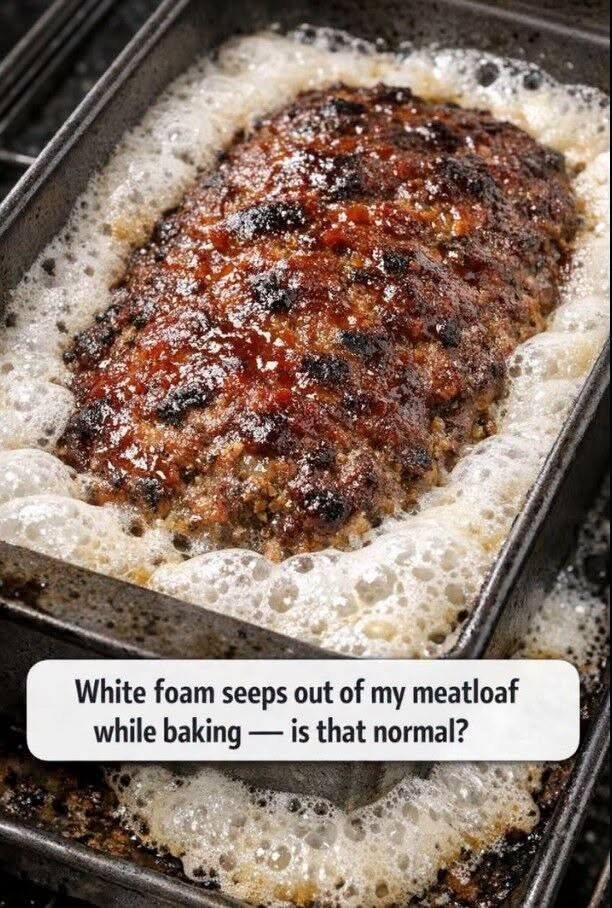
Seeing white foam seep out of a meatloaf while it bakes can certainly make you stop and wonder what is happening. Fortunately, that pale, foamy substance is often simply a combination of proteins, melted fat, and moisture released as the ground meat heats. It can be especially noticeable in meatloaves made with higher-fat ground meat, and ingredients such as eggs and other binders can also influence the final appearance.
So, if your meatloaf develops a little white foam in the oven, there’s usually no reason to panic or throw dinner away solely because of how it looks. Instead, focus on the things that actually matter for food safety: the freshness and storage of the raw meat, good kitchen hygiene, avoiding cross-contamination, and cooking the meatloaf to the appropriate internal temperature.
For meatloaf made with ground beef, pork, veal, or lamb, USDA recommends an internal temperature of 160°F (71.1°C), measured with a food thermometer. Meatloaf made with ground poultry should reach 165°F (73.9°C).
Most importantly, don’t use foam, browning, or the color of the center as your only indication that the meatloaf is ready. A reliable thermometer gives you much more useful information than appearance alone.
In the end, that strange white bubbling around your meatloaf may simply be a normal part of cooking. Once you understand what causes it, it becomes much less alarming—and you can concentrate on the things that really matter: preparing the meat safely, getting the texture you enjoy, and serving a warm, comforting homemade dinner.